Sunday, September 21, 2014

Hunting Water Prawns in Asanvari -- 8 Sept 2014


We arranged with Barry, the local that guided us to the Bat Cave last Saturday, to take us, along with another yachtie couple, into the bush to show us how he catches freshwater prawns. So, with mask and snorkel, and miniature pole spears, we followed him a short way into the jungle to a small stream.

We waded upstream, hopped from rock to rock, climbed over small waterfalls, stopping at pools along the way to hunt. Donning mask and snorkel, we lay down in the pools looking for prawns. There were many all around, but most were too small to bother with. The spear consisted of a piece of bamboo about a yard long, tipped with splayed points salvaged from the ribs of an old umbrella, and powered by a strip of rubber seized to the opposite end. This is exactly what I've used for many years hunting fish, except much smaller, so I immediately got into the game, bagging several prawns. Barry was the expert here, though, and it was just as much fun watching him. He knew every hole along the way, and came up with prawn after prawn. Several times, he disappeared under the water into some dark hole for a surprising length of time, making me think of Gollum in the Hobbit.

We finished the day with the four yachties on Mintaka for Thai curry with prawns. 

Bat Cave and Laundry Day in Asanvari, Maewo, Vanuatu -- 6 September 2014

We were well past due for washing clothes when we arrived here in Asanvari yesterday. But we had a higher priority today. There is a cave high on the mountain near here called Bat Cave, which, as you can imagine, is home to countless bats. Actually, some birds ("pijin") also nest inside the cave. Anyway, a local man here guides visitors up to see it for a small fee. Some friends of ours who visited it a number of years ago considered it a "don't miss" activity. So, we arranged yesterday to meet the guide, Barry, on shore this morning at eight o'clock.

Barry doesn't speak much English at all, nor French which is also a possibility here, only his local language (one of many here) and Bislama. But we've been working hard these few weeks on Bislama, and we had a great time conversing completely in it. A little stilted, perhaps, but still quite enjoyable.

We knew it would be a long hike up a steep, muddy trail -- I use that word loosely here -- for an hour and a half, or so. It was, indeed, both steep and muddy. We came to these islands with no footwear save flip-flops, so we found some sneakers to buy in Vila just for hikes such as this one. It wasn't long, though, before I was wondering if flip-flops might not be better here. Barry was wearing them, or occasionally going barefoot, and he was not slipping and sliding nearly as much as us. But we persevered for a couple of hours, Barry pausing to show us some plant, or an old village gravesite, or to chat about something ("samting") in Bislama. Actually, he couldn't seem to walk and talk at the same time, and I was beginning to wonder if we'd get there and back in one day. But we did, of course.

Bat Cave was cool. Just inside the entrance, there are some human bones and a partial skull from antiquity. Stepping further inside, bats flying all around us, we scrambled along with flashlights. About the time we lost the light from the entrance, we began to see a glow from another opening. Reaching that second opening, we saw it was a giant hole in the cave roof, extending down into an equally giant hole in the cave floor, descending into an abyss. Barry said that no one has ever gone down this hole, but that it apparently connects with a lower cave accessible from another entrance. The cave was interesting, and was of course the motivation for this hike, but it was the hike itself and the interaction with Barry that I enjoyed the most. He, like so many ni-Vanuatu, has an infectious smile and a warm, open personality. He seems to really enjoy the contact with visitors, showing them something of his island and its ways. As we have so often found, he also responded enthusiastically to our attempts at his language.

Slipping and sliding down the path ("smol rod"), it began to rain, not making traction any better. After a drippy beginning, it gained momentum, setting in to be an all-afternoon tropical downpour. We hadn't brought rain jackets, and were soaked to the skin with warm rain, but that was preferable to being soaked to the skin with warm sweat underneath rain jackets.

So, that leads into laundry day. Considering that fresh water is a valuable commodity on a boat -- we have to either make it, fetch it, or catch it -- and laundry takes a lot of it, we rowed back to Mintaka quickly to set buckets under our rain-catchment hoses. Within minutes, both buckets were full and emptied into our laundry basins. Robyn -- bless her soul -- sat out in the rain scrubbing and rinsing two weeks worth of clothes, sheets and towels. Then, she strung our clothes lines, hanging things up for a further rinse before taking them down again, lest they blow away. No chance of drying them today; that'll have to wait till tomorrow. 


Vanua Lava Days Festival, 1 - 4 Sept 2014

We had heard about cultural festivals in Vanuatu, where one can see "custom" dancing, and other traditional arts or events. Most of these festivals were already over for the season by the time we arrived in Vanuatu, however. The only one remaining with enough lead time for us to reach was in Vureas Bay on Vanua Lava. Vanua Lava is in the Banks group, far to the north, but there was just enough time to get there if we hurried. We don't usually hurry like that, but this time we did, stopping only one or two nights in any one place along the way.

The goal of attending this festival soon after entering the country did work well with the prevailing winds, which blow along the island chain from south to north. The resulting strategy then was to shoot north to the festival with the prevailing winds, then use the occasionally different winds to work our way slowly back south to Port Vila and maybe Tanna, even further south, before leaving for New Caledonia in October. So, with very little idea what to expect, we set off to the north.

The first leg, to the southern tip of Malekula, was a great overnight run. We spent two nights there (another blog entry), then a great daysail up to Port Stanley. Only one night there -- a real shame -- then a nice day sail again to Vao Island (also another blog entry). Two nights there, another great day sail, another one night anchorage, and a final great overnight sail. All of this sailing was downwind, and I couldn't help wondering all along if we were going to pay dearly, with a long upwind slog back.

Our first stop on Vanua Lava -- we arrived on a Saturday, and the festival was to begin on Monday -- was in Waterfall Bay, just a few miles to the north of Vureas bay. A twin waterfall plunges scenically, directly into the sea here. There is a no village, but several families live along the shore in the area. One of the two paramount chiefs of the island lives here, Chief Kerely, who welcomed us, and soon became a friend. Snorkeling along the shore here, we also found one of the best displays of coral we've ever seen -- great diversity and extent, along with a fascinating topography. Chief Kerely grew up in the village in Vureas bay, and took the opportunity the next day to ride with us down there for a visit. Besides enjoying his company, having him introduce us to the other paramount chief of the island, Chief Godfrey of Vureas Bay, was a good start there.

Chief Godfrey is seventy-five years old, a small, wiry man with regal presence. Like so many people here, his infectious smile and warm, open welcome made us feel immediately at ease and at home. We came to regard him with great affection in just a few days.

The purpose of this annual festival is twofold, to commemorate the loss of an entire village here by an earthquake, landslide and tsunami on September 1, 1945, and to revive and teach traditional customs. Striking in the night, over seven hundred people, all but a lucky few, were lost in that tragedy. Chief Godfrey was one of those few, carried by his parents uphill into the bush in the dark. We visited the ruins with the Chief, just a short walk down the shore. The earthquake lifted the land there, so it is now a bit inland. During the war, the Americans landed on the beach by the village. Now there is a section of jungle between it and the beach. Incidentally, the Americans are remembered well here. Apparently, they treated the native people well. One man told us he still has a tea kettle that was given to his father back then. Little is left there now, but we did see the ruins of the church and the baptismal font (made from one half of a giant clam, a Tridactna gigas) where the Chief was baptized as a baby.

The cultural part of the festival mostly consisted of traditional dances, each of which told a story, which of course was lost on us. We did enjoy the exotic dances, though, with the dancers dressed in grass skirts, various flowers and feathers, and accompanied by local percussion instruments. One of these instruments is called a tamtam, or slit drum. It consists of either a section of bamboo or a hollowed log. In either case, there is only a single narrow opening, resulting in a resonant chamber. The other instrument is a heavy round wooden disk, perhaps a yard in diameter. It is set over a hole in the ground, also creating a resonant chamber, and is rhythmically pounded by men with heavy poles, vaguely reminiscent of a mortar and pestle. Besides these two, most dancers had seed-pod rattles secured around their ankles.

Most of these dances were performed by men, a few by women, but never mixed. There were quite a few of these traditional dances over the several days, but there were also two "public" dances, where anyone could join in. These both quickly became joyous mobs, prancing, shuffling, circling the drummers. The few yachties in attendance gladly mixed in, even me, who has always maintained, "I don't dance."

Besides the dancing, Chief Godfrey's youngest son took us for a long walk in the jungle to see a Megapode, an almost extinct flightless bird that lays its rather large eggs in warm volcanic soil, and also to see how they catch freshwater prawns. After several kilometers, we came to a native homesite, several thatch-roof structures with woven bamboo walls and rough plank floors. A man and two small boys, dressed in grass skirts, and painted even blacker than natural -- I was quite taken aback -- led us further into the jungle, all the while drumming lightly on a small tamtam, chanting and calling his semi-tame bird. After a while, we hear the bird answer the call, and eventually the bird came close enough for us to get a good look. Next, the man showed us his cleverly woven trap which he had baited with grated coconut and left in a stream the day before. It contained about two dozen prawns, which he gave to us, and which we cooked and ate later that day. Only upon arriving back at his homesite did the man speak any English, or for that matter Bislama (there are a multitude of local languages here; the only one in common is Bislama, a relatively recently invented creole language). Only at that point did I recognize him as Frank, Chief Godfrey's eldest son, whom I had met him the day before, dressed neatly in tee shirt, shorts, socks and sneakers. The change was so dramatic, and so unexpected, that I didn't recognize him. This was no act, though, rather a different part of his identity, one he grew up with, and which was just as comfortable to him as western dress.

The last morning before we left, a group of women from a neighboring island performed "water music". This consisted of the women, wading in waist deep water, slapping the water in such a way as to create a rhythm with several different sounds. Unique music, to be sure, and they have taken it as far as Europe.

We had gone to this festival not knowing what to expect. What we found there were wonderful people celebrating their heritage, much like an American-Indian powwow. What struck me most was that, even though their customs are radically exotic to me, they are just people, not much different than anywhere else. Actually, they are different. They are polite, shy, and warmly welcoming, far more so than I've ever seen anywhere else, and it is their national character. 


Sunday, August 17, 2014

Recent Pictures

                                                        Sunset anchorage at Wallis

                                                                  Fete at Futuna

                                                                     Fete at Futuna

                                                                   Fete at Futuna

                                                                   Fete at Futuna

                                                                Fete at Futuna

                                                                     This is a drum.

                                                        Traditional house on Futuna

                                                              July 14th on Wallis

                                                               July 14th on Wallis

                                                               July 14th on Wallis

                                                          In the Pierre Chenal church

                                                           In the Pierre Chenal church

                                                    Traditional house in Mele, Vanuatu

A Ni-Vanuatu Friend

Robyn has a life-long friend from Minneapolis, who married a Brit and now lives in Britain.  She, in turn, has a niece who is half British and half ni-Vanuatu (that’s what the locals here call themselves).  This niece — Serah is her name — has been attending University in Britain, but is home in Vanuatu right now.  She lives in the little village of Mele, not far from where we are now in Port Vila.  We met her Saturday, and had Sunday lunch with her family yesterday.

How we found her deserves a telling.  There was a charity horse race sponsored by the local Kiwanis club Saturday near Mele.  A local event, it sounded interesting.  We had been having difficulty contacting Serah, but managed to get a message to her uncle that morning that we would be at the horse races.  He said she would come out there looking for us, that we should wait at the gate, and that Serah was tall and light-skinned (half British) with curly dark hair.  Robyn wore a bright orange T-shirt for Serah to seek (that, with a white face in a sea of black ones was distinctive).  So, we went out there Saturday morning and found that one of the gate tenders actually knew Serah, and said he would watch for her.  We went on in, but after the first two races, we were ready to leave.  Serah hadn’t shown up yet, so we got a ride to her village, and asked the first person we saw if they knew Serah.  “Oh, yes.  Go down this street, take the third left, and ask someone for further directions.”  We did.  “Oh, yes.  Go down to where you see the laundry drying on a line, and ask someone for further directions.”  We did.  The next person was tall and light-skinned, with curly dark hair, and lit up when she saw Robyn’s T-shirt.  We had a very nice visit, met some of her many relatives, and had some local food before catching a bus back to Port Vila.  Serah’s mother invited us back for Sunday lunch.

Mele is a small village, where pigs and mangy dogs roam the dirt lanes, and the small houses are a mix of cement, corrugated metal, and thatch.  Many floors are dirt, and are covered with mats, finely woven from pandanus leaves.  Everyone seems to know everyone, and everyone is very friendly.  One young man called out to us, “Thank you for visiting our village.”

We caught a bus up there again Sunday morning, arriving at Serah’s house — I should say her extended family’s group of houses — amid a croud of her relatives preparing various foods for lunch.  Men tending several rather large dutch ovens simmering chicken; four women preparing platters of salad.  Another, a huge bowl of a sort of spicy coleslaw.  Two other women grating coconut meat to squeeze for coconut milk to go in the rice.  Etc, with all of the cooked dishes being done over open fires.

We were a little early, so we went for a stroll, stopped by the church where some big conference was getting underway, and wandered around the village a bit.  Then we just hung around, watching the preparations, meeting some of the family.  Serah wasn’t around yet; turns out she was in the church service.  At one point, Serah’s mother presented Robyn with a handmade dress like all the other women were wearing, and a bit later presented me with a brightly colored shirt, also hand made.  No explanation, though.  Later, we found that this was a family tradition with visitors.  Then we sat down with the family at a very long table for a nice meal of local dishes.  Serah showed up, and we had another nice visit.  Just before leaving back to Port Vila, Serah’s mother presented us with one of their woven mats, a special, ornate one.  We were quite taken aback.  It was a pleasure, as well as a cultural experience, to be included in the family like that.

Futuna

Futuna is rarely visited by yachties, or by other tourists.  This is partly due in the case of yachties to the poor anchorage, and to its out-of-the-way location, but also in general to no great interest in tourism among the people of Futuna, and little of interest to a tourist — just a pretty little tropical island, where people go about their lives quietly.  The population is small, and there is no industry.  Consequent to all of that, there is almost nothing in the way of restaurants or hotels.  The people are quite friendly, though, and seem pleased that we’d come to visit.

The day after we arrived was the 29th of August, anniversary of the day Wallis and Futuna became French Overseas Territories.  The day started with a mass at the main church, a quite colorful, flower-bedecked affair, with spear-carrying ushers in attendance who struck the floor with a spear butt whenever the people were to stand.  I’ve not been to that many Catholic masses, but I found myself wondering if the average western Catholic would have recognized this as their own religion.

The day continued with a flag ceremony, quite a bit less elaborate than for the 14th of July, and a kava ceremony for the VIPs of the island.  A succession of dancing, costumed school groups performed over the morning.  Then, a community feast was served.  “Served” doesn’t quite fit here, though.  Typically polynesian, the food was piled high on a long table.  People sat as space allowed, eating mostly with fingers from the heaped up dishes, then left, making room for others to sit down and eat.  Total chaos.  I am actually intimidated by this sort of thing.  I’m not sure why, but I am.  Were it not for Robyn, I would never have entered the room, let alone sat down.  Robyn and I are good at getting the other into good experiences which we would not otherwise have.

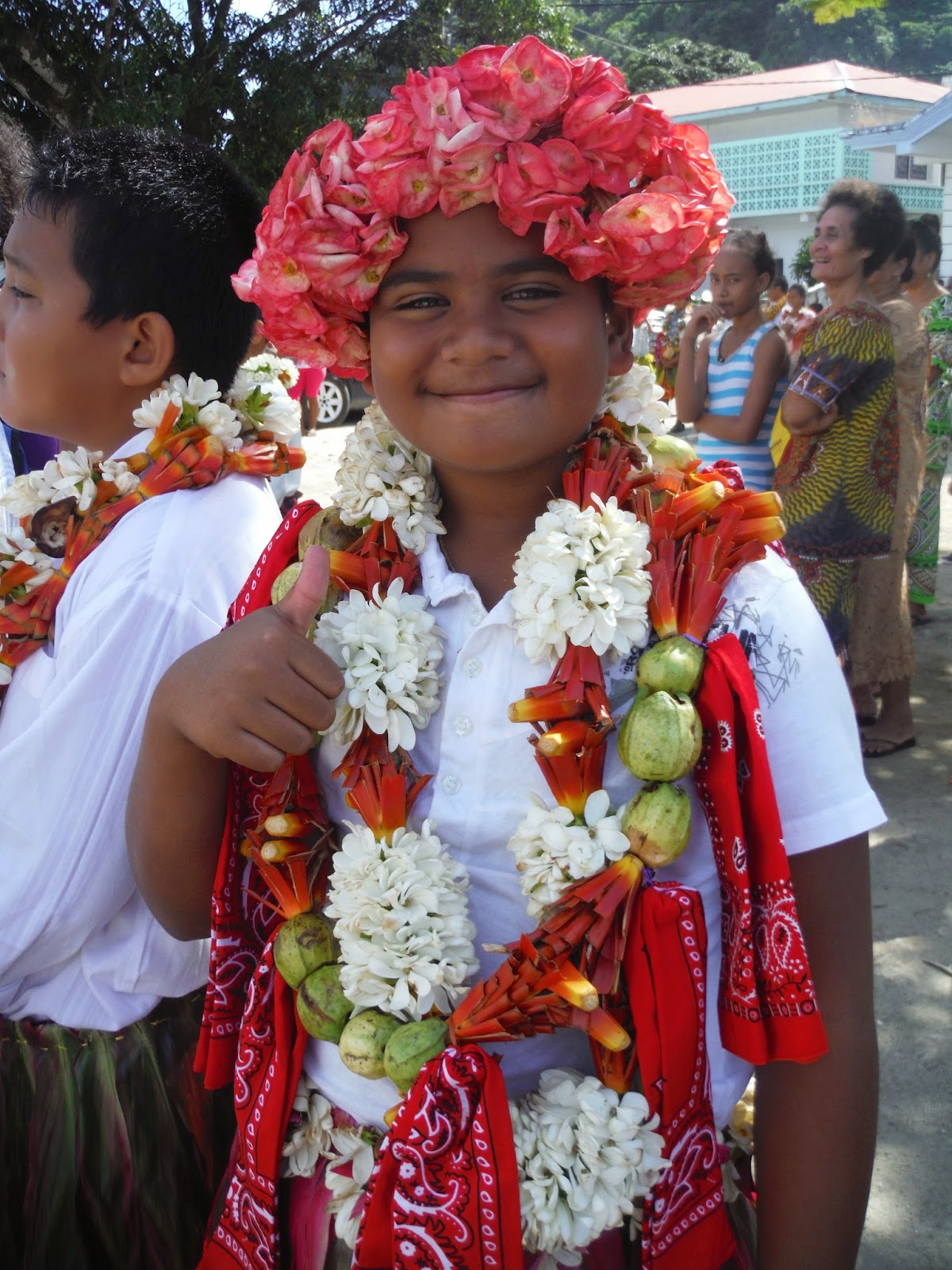
The afternoon then continued with groups of male dancers, deck out in an eclectic mix of leaves, other bits of foliage, and strips of brightly colored mylar.  These men clearly enjoyed this dance tradition, stomping, swinging, jumping in unison to the beat of makeshift drums.

We noticed that there were no local fruits in the grocery store — no coconuts, bananas, papayas, etc.  We asked where we could buy some, and were told to just ask at any house where we saw them growing.  We did so a couple of times, and were always told to just take what we wanted.  One of these times, we were also invited in for lunch.  After seeing the wretched conditions in which the pigs are kept, I wasn’t too keen on the roast pork.  Oh, well.  The roast taro wasn’t so great, either, but the encounter with the local man was great.  His French wasn’t so good — worse than mine — but we managed to communicate well enough.

Futuna is a pretty island, but there isn’t actually much to see or do as a tourist.  The only thing of interest in the Lonely Planet guide was the Pierre Chenal church at the other end of the island.  Chenal was a priest here in the early days, was killed by a jealous chief, and is now the patron saint of Oceania.  The church is a little different, with intricately woven tapa cloths lining the walls, and with the crucifix figure clothed in tapa cloths.  The chapel next door contains some of Chenal’s relics — bones, skull, the club that killed him, etc.  I get the feeling, visiting various Catholic churches around the islands, that Catholicism has not replaced the former paganism here so much as absorbed it.


We had wanted to go north from Futuna to visit Tuvalu, but a nasty weather system was parked between Futuna and Tuvalu, and didn’t look like it was going to move any time soon.  We were getting antsy to move on, and when the weather looked OK to go west to Vanuatu, but still bad to the north, we reluctantly decided to forget Tuvalu.  Unlike travel on land, we go where the weather allows us to go.

Passages from Wallis to Futuna to Vanuatu

We pulled in to Port Vila in Vanuatu late in the evening last Monday, the 11th.  We don’t like to enter new ports after dark — we don’t like to enter familiar ones after dark either — but Port Vila is an easy entry, even in the dark, and the full moon gave considerable light, despite the overcast.  It didn’t help, though, that the last of our three autopilots had become unreliable (occasionally generating an uncommanded hard turn, not a good thing in tight places), so I had to hand steer the last few miles.  The entry into the port follows what is called a lighted range.  That consists of two distinct lights, one above and further inland than the other.  If you are on the range, the two lights will appear one directly above the other.  If you are off the range, one light will appear to one side of the other.  This range defines a line with perfect accuracy, which is set up to ensure a safe enry.  It didn’t help, though, that only one of the lights was operating.  Fortunately, we have other means of following such a line.  It didn’t help, too, to find quite a few boats anchored in the small and awkward and dark quarantine anchorage, two quite large, and several of the others unlit (very bad form not to have an anchor light on at night).  Well, we finally found a suitable spot, and got the anchor down, six and a half rough, wet and salty days from Futuna.

I should go back to leaving Wallis, though, where I posted my last blog entry.

Wallis is an atoll with only one significant pass through the fringing reef.  The tidal currents in such a place can run quite strongly, so you have to time your transit of the pass accordingly.  With an unavoidably strong wind against us, we needed a bit of current behind us to help, so we left about an hour before low tide.  Wind against current can set up some impressive waves, which was the case here.  The tongue of water rushing out the pass bore a distinct resemblance to the log flume at Disney World.  Tall but short and steep waves sent us alternately soaring skyward or falling down, down, down.  Didn’t last too long, but it sure was wild.

The wind was at right angles to our course for Futuna, some hundred and thirty miles or so away, and was blowing around twenty-five knots.  This made for a fast but wet ride.  The waves were coming up beam on, with an occasional one peaking at just the right moment to smack hard against the side of the boat (sounds like a gun shot down below when one does that).  Well, the wave energy has to go somewhere, so it shoots straight up, whereupon the wind blows it onto the deck, into the cockpit, and now and then a bit down the hatch.  Didn’t take long to get very wet and salty.  The conditions eased just a bit along the way, but were still up when we arrived at Futuna.

The anchorage at Futuna is just a small notch in the fringing coral reef.  There was just enough protection to make the anchorage tenable, but not by much.  A heavy swell rolled in continuously, making us pitch uncomfortably.  And the wind was now at an angle to the swell, so it allowed us to roll miserably.  We wound up using three anchors, two off the bow to hold us in the notch, and one off the stern to hold us facing the swell to stop the rolling.  With the three anchors holding us in place, conditions were tolerable, but not very comfortable.  I was a little nervous the whole week we were there.

Futuna was nice enough — I’ll describe our time there in the next blog post — but when the weather allowed us to leave, I was quite ready.  The conditions had only dropped back down to what we had coming over from Wallis, though, still blowing 20-25 kts with rough seas.  Once again, it didn’t take long to get very wet and salty.

We had intended our first stop in Vanuatu to be at Tanna island, where there is an easily accessible active volcano.  You can get a ride by truck up to a short walk from the rim of the crater, where you can look down into Dante’s inferno.  The volcano bubbles and spits, and occasionally sends blobs of lava skyward to get the attention of visitors — the recommendation is not to run, but to look up so you can avoid the blobs as they land.  I can’t really say that it’s a safe, or smart thing to do, but countless tourists have gone up there over the years, with only a couple of accidents.

The problem is that the port of entry on Tanna is on the wrong side of the island, and doesn’t have much of an anchorage.  Considering the rough weather we were experiencing, we finally decided to skip Tanna for now, and head directly to Port Vila, the capitol of Vanuatu, where we are now.


We’ve had a couple of good night’s sleep now, washed all the salt off, and are enjoying the town and the company of other cruisers.  I’ll write about Futuna soon, as well as Port Vila.  Stay tuned.